VMEbus was specified in 1981 around the Motorola 68000 and the Eurocard mechanics that European instrument makers already had on the shelf. Forty years later there are still power stations, particle accelerators, radar installations and naval systems running VME crates, and there are still companies selling new boards for them.
Why it lasted
Three decisions made the difference. The bus is asynchronous, so a fast board and a slow board can share a backplane without either being clocked down to the other. The mechanics are a published standard rather than one vendor’s product, so a crate could be filled with boards from five suppliers. And the connectors are two or three DIN 41612 blocks with positive retention — an interface designed for equipment that gets shipped, dropped and serviced.
What a crate looks like
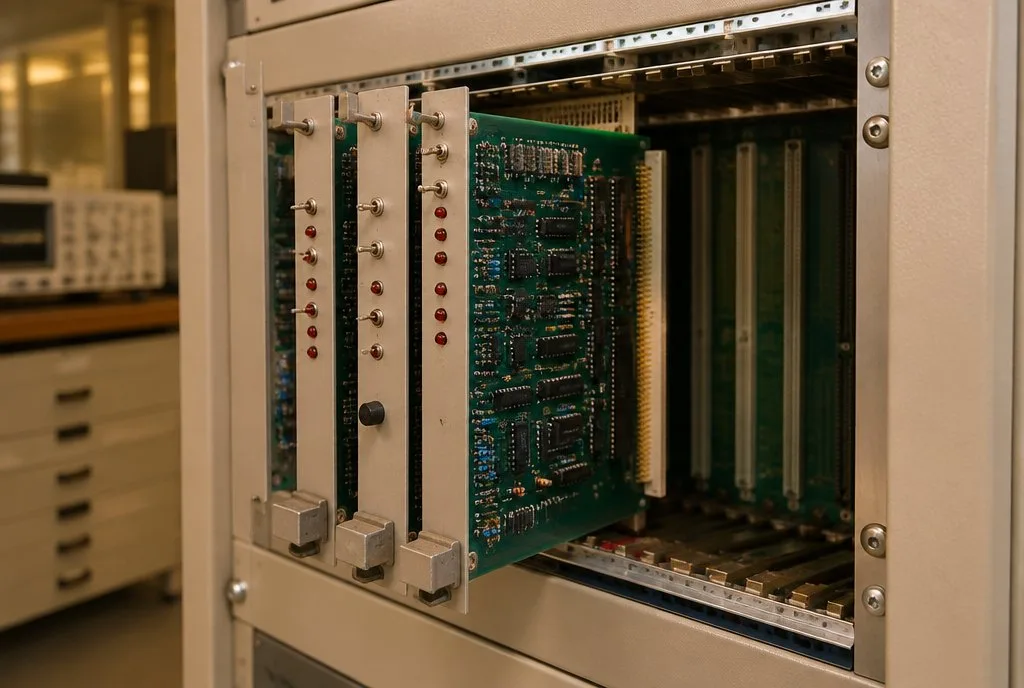
A 6U board measures 233 by 160 millimetres and plugs into a backplane at the rear of a 19-inch subrack. Slot one holds the system controller, which supplies the bus clock, the arbiter and the reset logic. Everything else is peripheral: processor boards, digitisers, motion controllers, serial concentrators. Addressing is flat and physical, which makes a VME system straightforward to reason about and unforgiving of a mis-set jumper.
The successors
VME64x widened the data path and added hot swap and geographic addressing. VXS and VPX replaced the parallel backplane with serial fabrics while keeping the subrack. Each step solved a real bandwidth problem, and each one made the installed base a little more expensive to extend — which is precisely why so many sites are still running plain VME.