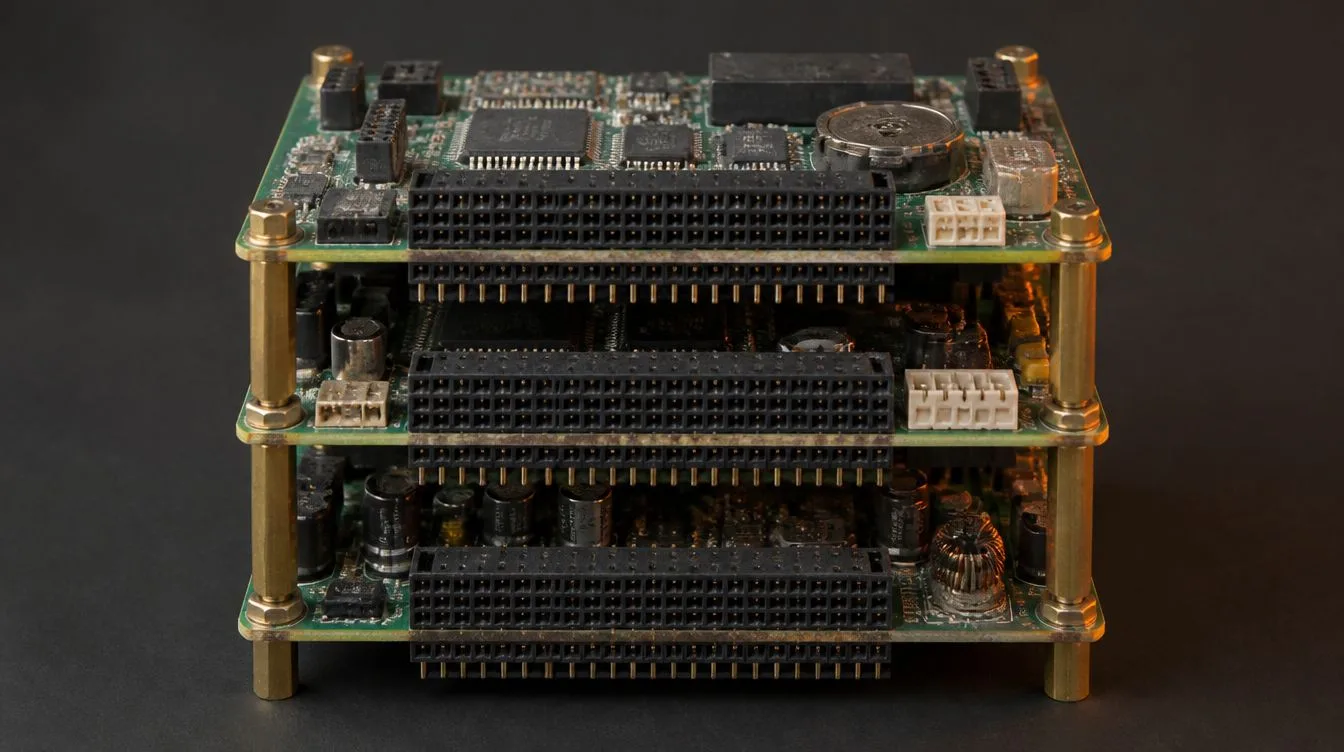
PC/104 solved a mechanical problem before it solved an electrical one. An industrial controller that has to survive vibration cannot rely on a card edge sitting in a connector that was designed for a desktop tower. The answer, published in 1992, was to drop the backplane entirely: boards measure 90 by 96 millimetres, carry a stacked pin-and-socket bus on one corner, and bolt to each other through four standoffs.
What the format actually specifies
The specification covers three things and deliberately stops there: the board outline and mounting holes, the position and pinout of the stack-through connector, and the reduced drive currents that make a stack of eight boards electrically sane. Everything else — the processor, the power budget, the enclosure — is left to the designer.
That restraint is the reason the format outlived its bus. The original stack-through connector carries ISA signalling, which no new design would choose today. PC/104-Plus added a second connector for PCI, PCI-104 dropped the ISA half, and PCIe/104 moved to serial lanes. The mechanics never changed, so a 1994 enclosure still accepts a module built last year.
Where it still turns up
Rolling stock, agricultural machinery, test benches, military vehicles: places where the equipment is expected to run for twenty years and where nobody will ever open the housing to reseat a card. The stack has no moving contacts, no cage, no card guides that can bend, and the whole assembly is held together by screws that a technician can torque to a documented value.
The trade-off
Stacking is thermally awkward. Each board sits roughly fifteen millimetres above the last, with no air path designed in, so heat leaves through the standoffs and the enclosure wall or it does not leave at all. Designs that ignore this run fine on the bench and fail in a sealed box in July. The usual remedy is to put the hottest module at the top of the stack and give it direct metal contact with the lid.